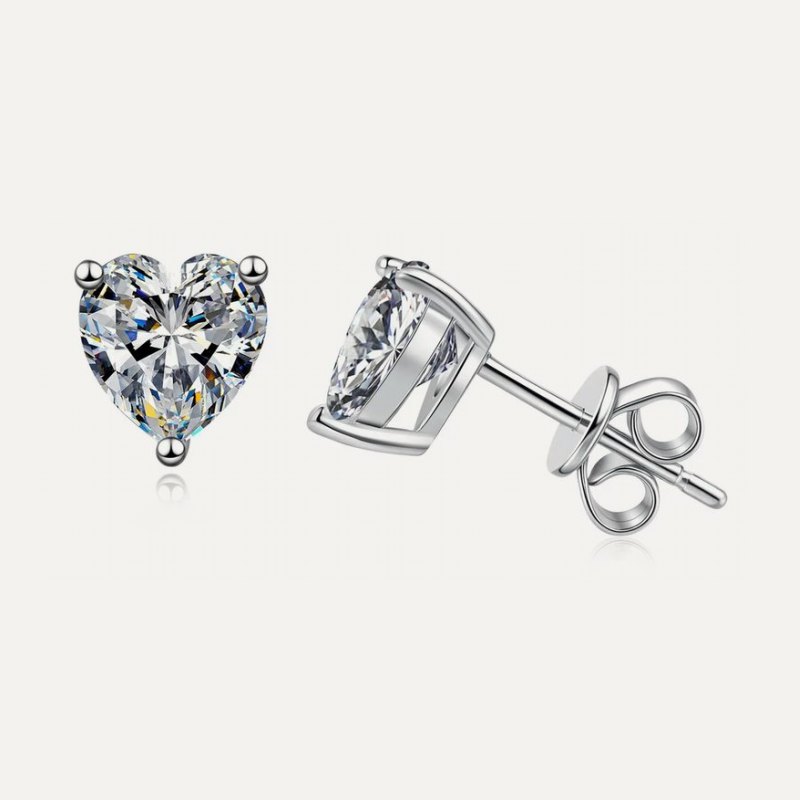
Moissanite and stones
Moissanite grading and GRA reports: grades, size chart and how to check one
Short answer
Moissanite is lab-grown silicon carbide, graded on the diamond scales: color from D (colorless) down, clarity from FL to I. Market-wide, it is mostly sold as D to F color, VVS to VS clarity. A GRA report records the grade and a report number; checking the number online and the stone's size against the card ties the card to the stone.
On this page 9 sections
| Grade | Scale | What it means |
|---|---|---|
| Color | D, E, F | Colorless; the top of the scale |
| Color | G, H | Near colorless; slight warmth face up |
| Color | I, J, K | Faint yellow or green tint, visible in larger stones |
| Clarity | FL to I | Inclusions seen at 10×; see the clarity chart below |
| Cut | Excellent, Very good, Good | Proportions and polish, which drive brilliance |
A GRA card states the color, clarity and cut of its own stone. For a stone without a card, such as a pavé or tennis stone, ask the seller for the grade before you order.
What is moissanite?
Moissanite is silicon carbide (SiC). Henri Moissan found the first grains in 1893, in a meteorite from Canyon Diablo, Arizona. Natural moissanite is too rare and too small to cut, so all jewelry moissanite is grown in a lab. It is a gemstone of its own, harder than sapphire and with more fire than diamond.
| Property | Moissanite | Diamond | Cubic zirconia (CZ) |
|---|---|---|---|
| Material | Silicon carbide, lab-grown | Carbon | Zirconium oxide, lab-made |
| Hardness (Mohs) | 9.25 | 10 | 8–8.5 |
| Refractive index | 2.65–2.69 | 2.42 | 2.15–2.18 |
| Dispersion (fire) | 0.104 | 0.044 | 0.058–0.066 |
| Density, g/cm³ | 3.21 | 3.52 | 5.6–6.0 |
| Thermal diamond tester | Reads as diamond | Reads as diamond | Not diamond |
| Electrical (moissanite) tester | Moissanite | Not moissanite | Not moissanite |
Moissanite clarity chart
Moissanite clarity uses the diamond scale, but GIA identifies moissanite without grading it; a few labs such as IGI issue moissanite reports, but most jewelry moissanite is graded by the grower or on a GRA card. Across the market, most jewelry moissanite is sold as VVS or VS.
| Clarity | At 10× magnification | Face up, by eye | For a retailer |
|---|---|---|---|
| FL, IF | No inclusions; IF can show surface marks | Clean | Looks the same as VVS |
| VVS1, VVS2 | Minute inclusions, very hard to find | Clean | Common for center stones in the trade |
| VS1, VS2 | Small inclusions, found with effort | Clean in most sizes | Check stones over 6.5 mm |
| SI1, SI2 | Noticeable inclusions | Sometimes visible | Check every stone |
| I1–I3 | Obvious inclusions | Visible | Avoid |
Check clarity with a 10× loupe, face up, in daylight-type light. Moissanite splits light in two (doubling), so one inclusion can look like two.
Moissanite size chart: mm to carat
Round moissanite is sold by its diameter and its DEW, the carat weight of a diamond of the same size. The pairs below follow the standard round-diamond size chart and are the same as on our GRA certificate page:
| Round stone | DEW |
|---|---|
| 3 mm | 0.1 ct |
| 4 mm | 0.25 ct |
| 4.5 mm | 0.35 ct |
| 5 mm | 0.5 ct |
| 6.5 mm | 1 ct |
| 7.5 mm | 1.5 ct |
| 8 mm | 2 ct |
Each style on wholesale moissanite jewelry gives the center stone in ct DEW, with the diameter for round stones; pavé and tennis styles give the stone size in mm. Stud pairs, per stone and in total: stud and hoop earring sizes.
Carat weight and DEW
Moissanite is lighter than diamond (density about 3.21 against 3.52 g/cm³), so a stone the size of a 1 ct diamond weighs about 0.9 ct. That is why sellers quote DEW, diamond equivalent weight, instead of the stone's own weight.
Is moissanite a real diamond?
No, and it is not a lab-grown diamond either. Moissanite is lab-grown silicon carbide; a diamond, natural or lab-grown, is carbon. US rules define a diamond as a mineral of essentially pure carbon and treat calling anything else a "diamond" without a qualifier as deceptive. When you resell, describe the stone as lab-created moissanite with its size as DEW ("1 ct DEW lab-created moissanite"); do not call it diamond, lab diamond or lab-grown diamond.
GRA certified moissanite: what the report is, and is not
GRA reports are grading cards issued for moissanite through the supply chain. They record shape, size, DEW, color, clarity and cut, with a report number. They are a traceability record, not an independent lab grading like the reports gem labs issue for diamonds. Their value to a retailer is that the number on the card matches the record online and, if the stone is inscribed, the number on its girdle.
How to check a GRA report
- Read the report number on the card.
- Enter it on the GRA lookup site printed on the card. Type the address yourself rather than following a link, because look-alike sites exist.
- Compare the online record with the card: shape, size in mm, DEW, color and clarity.
- Measure the stone with calipers and check its size against the DEW on the card. If the stone is inscribed, match the girdle number too: it is on the thin edge of the stone, read under a 10× loupe.
- To tell moissanite from diamond, use a moissanite tester, which reads electrical conductivity; a thermal tester alone cannot. Under a loupe, moissanite also shows doubled facet edges when viewed at an angle.
Our GRA cards
Which of our pieces ship with a GRA card, and how to look one up: GRA certificate lookup.
Sources
- US Federal Trade Commission, 16 CFR 23.12, definition and misuse of the word "diamond".
- Moissanite, Wikipedia and Cubic zirconia, Wikipedia: discovery, hardness, refractive index, dispersion and density.
Questions buyers ask
Do moissanite pieces come with a GRA certificate?
Every moissanite stone from 0.3 ct DEW ships with its own GRA report card, and the card states that stone's grade. Smaller pavé, side and tennis stones have no individual report.
How do I check a GRA report?
Enter the report number on the GRA lookup site printed on the card, compare the record with the card, then measure the stone and check its size against the carat on the card.
Step by step: how to check a GRA report. Our numbers are on the GRA certificate page.
Will moissanite pass a diamond tester?
A thermal diamond tester reads moissanite as diamond. A moissanite tester, which measures electrical conductivity, or a loupe check for doubled facet edges tells them apart.
What size is a 1 carat moissanite in mm?
6.5 mm for a round stone, sold as 1 ct DEW. A 5 mm round is 0.5 ct DEW and an 8 mm round is 2 ct DEW.
See the moissanite size chart.
Is moissanite a real diamond?
No. Moissanite is lab-grown silicon carbide; a diamond is carbon. It is a gemstone of its own, 9.25 on the Mohs scale against 10 for diamond, and US rules forbid selling it as a diamond.
A GRA card does not make it a diamond either: GRA moissanite is real moissanite with a grading card. Sell it as lab-created moissanite with its size as DEW ("1 ct DEW lab-created moissanite"), never as diamond, lab diamond or lab-grown diamond. See moissanite and the word diamond.
How can you tell if moissanite is real?
Use a moissanite tester, which reads electrical conductivity: real moissanite registers as moissanite, while cubic zirconia (CZ) and glass do not. Under a 10× loupe, moissanite also shows doubled facet edges.
For a stone with a GRA card, enter the report number on the lookup site printed on the card and measure the stone against the carat on the card: how to check a GRA report.
More answers in the wholesale FAQ.